6 AI signal agents, one selector, two writers: the split-signal architecture
A London-based CX outsourcer (GBP 30-40M revenue) needed personalization that doesn't read like a mail merge. Six specialized AI agents each hunt one signal type; a selector picks the strongest; two writers turn it into copy.
The Client
Global CX outsourcer, GBP 30-40M revenue, London-based.
The Problem
Generic outbound was invisible to enterprise CX buyers.
The Build
Multi-agent AI personalization: 6 signal hunters, transformation scoring, BPO exclusion gates.
The Outcome
859 companies scored and routed, 12 domains warmed, 30K monthly capacity ready to fire.
Context
The client
A London-based customer experience outsourcer with operations on four continents. Instead of throwing headcount at every problem, they combine human expertise with agentic AI to replace FTE-heavy delivery with AI-orchestrated business processes. Revenue sits around GBP 30-40M, with 25M+ customer interactions handled per year across 20+ markets.
They came to me with no CRM access, no prior outbound copy, and one hard rule: the outreach had to feel specific to each enterprise buyer, not like another templated blast that a CX leader deletes on sight.
Constraints
Why this was hard
- They had been burned. Previous lead-gen providers delivered generic messaging and zero conversions. Quality over speed was a contractual expectation, not a platitude.
- BPO exclusion was contractual. Never email another outsourcer, call center, or direct competitor. That exclusion had to be enforced at the data layer, not left to the copy.
- No existing assets. No CRM, no analytics, no templates. Every layer, from data architecture to copy, had to be built from scratch.
- Enterprise ICP, narrowly defined. Target revenue GBP 100M-5B+, headcount 500-10,000, across retail, travel, home services, food on demand, and financial services, with a hard cap of 3-4 contacts per company.
- Messaging had to match transformation maturity. A company that treats outsourcing as a cost lever needs a fundamentally different email than one that sees it as a technology transformation.
Architecture
The system
One pipeline, built around a strict separation of jobs. A company universe passes a BPO exclusion gate, then six signal agents run in parallel, a selector picks the single strongest signal, and only then do two writer agents turn that clean fact into copy. Research and copywriting never happen in the same prompt.
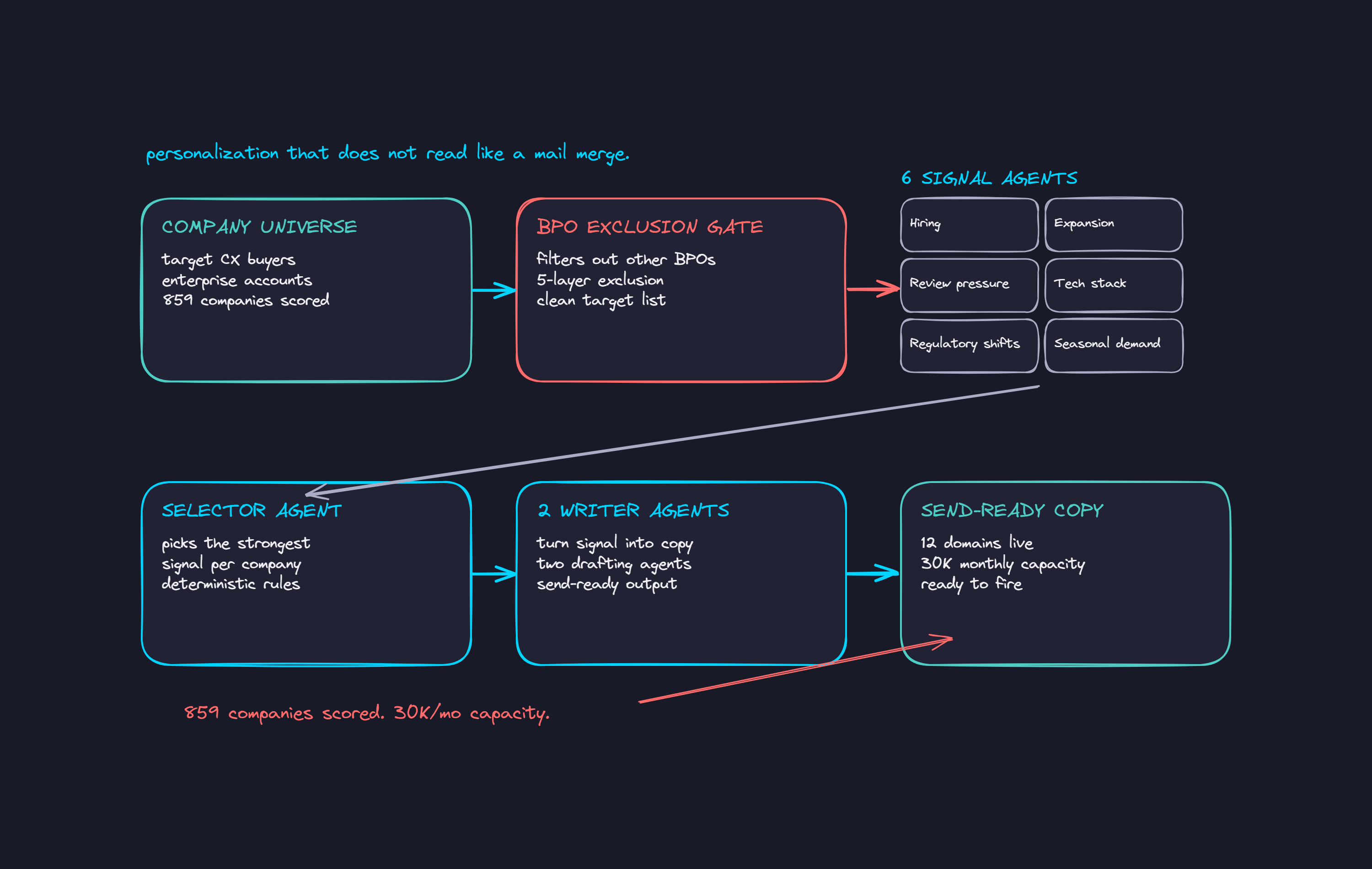
Company universe & enrichment
859 companies passed through domain normalization, LinkedIn resolution, Apollo enrichment, and revenue and headcount filtering against the enterprise ICP, before any signal work began.
5-layer BPO exclusion gate
Industry classification, keyword scans on company descriptions, a hard-coded competitor blocklist, geographic exclusion, and a manual-review flag. Enforced at the data layer so no competitor ever entered the send queue.
6 parallel signal agents
One job each: hiring, expansion, review pressure, tech stack, regulatory shifts, and seasonal demand. Each agent hunts a single signal type instead of one model juggling research and writing at once.
Deterministic signal selector
A priority cascade, not AI, picks the strongest signal: hiring beats expansion beats review beats tech beats regulatory beats seasonal. If all six return null, a tenure-based fallback fires. Fully auditable: I can see which signal won and why.
2 writer agents
One writes the 1-2 sentence personalization line from the selected fact, the other writes the subject hook. No searching, no deciding, just writing from a pre-cleaned signal.
Transformation scoring & sender infra
Every company scored into 3 transformation-maturity tiers to route the right value proposition, backed by 12 warmed domains and 4 sender personas at roughly 30K monthly capacity.
Results
Infrastructure delivered
This engagement was a pre-send infrastructure build. There are no campaign results to report yet: the deliverable is the architecture and the assets below, all live and ready to fire.
| Everything that exists today | |
|---|---|
| Companies scored & routed | 859 |
| Signal agents (one job each) | 6 |
| Selector + writer agents | 1 + 2 |
| Transformation maturity tiers | 3 |
| BPO exclusion layers | 5 |
| Sending domains warmed | 12 |
| Sender personas built | 4 |
| Monthly send capacity | ~30,000 |
| Campaign status | Pre-send, ready |
The reason this is in my portfolio is not send volume, it is the methodology. The split-signal architecture solves a quality problem I had seen across every previous build: AI personalization that sounds plausible but is not grounded in a specific, verifiable company fact. Separating find the signal from write the sentence, with a deterministic selector in between, produces a measurable quality improvement. Every campaign I have built since uses this pattern.
Want personalization grounded in real signals, not merge tags?
Book a 15-min callFit
Who this is for
- Companies burned by generic lead generation that need to see the infrastructure before they trust the output. If your last provider called
{{first_name}}personalization, this is the alternative: agents that find real signals and writers that ground every line in a verifiable fact. - Businesses with contractual exclusion requirements where emailing the wrong company is a compliance failure, not just waste. The 5-layer exclusion gate enforces business-critical targeting at the data layer, with an audit trail at every stage.
- Enterprise-scale outbound targeting segmented buyer types where one message cannot serve all prospects. The 3-tier transformation model routes a structurally different value proposition to each buyer, not just a different subject line.
Stack
Tools used







Ready to build outbound where every line is grounded in a real signal?
See how the split-signal architecture turns a raw company universe into send-ready copy, with a verifiable fact behind every email and compliance enforced at the data layer.
Book Your Free Strategy Call