9 AI copy variants tested across 7,963 cold emails at a 0.53% bounce rate
A Switzerland-based outbound agency entering US B2B tech needed to know which messaging works before scaling. A 9-variant testing harness answered that with clean data and near-zero bounces.
The Client
Swiss B2B outbound agency expanding into the US tech market.
The Problem
No proof of which messaging angle lands with US buyers.
The Build
9-variant AI copy test harness on pristine deliverability infrastructure.
The Outcome
Statistically clean read on messaging at 0.53% bounce; the reply data told us the offer, not the copy, was the constraint.
Context
The client
A Switzerland-based B2B outbound agency that builds cold email campaigns for mid-market tech companies. They had a proven track record running campaigns for their clients, but had never turned the same methodology inward, and they needed their own outbound engine to sell lead generation services into the US B2B tech market.
The target was specific: companies with 50 to 1,000 employees, headquartered on the US East Coast plus Florida, Indiana, and the DC metro area. The ICP was decision-makers at B2B tech firms actively scaling their go-to-market function but lacking the infrastructure to do cold outbound well.
Constraints
Why this was hard
The agency needed to demonstrate outbound sophistication to prospects who evaluate outbound sophistication for a living. Every operational choice had to be defensible, because the campaign itself doubled as a live portfolio piece.
- The most skeptical audience in outbound. B2B tech leaders receive dozens of cold emails daily, so standing out required genuine, research-backed personalization, not templates.
- A saturated market. US East Coast tech is one of the most crowded cold email markets, so deliverability had to be flawless.
- Multiple angles, tested at once. I needed to read several messaging angles at the same time without hand-writing thousands of variants.
- Poor US mid-market data. Email data quality is notoriously weak here, and a single enrichment provider would miss 30 to 40% of valid addresses.
Architecture
The system
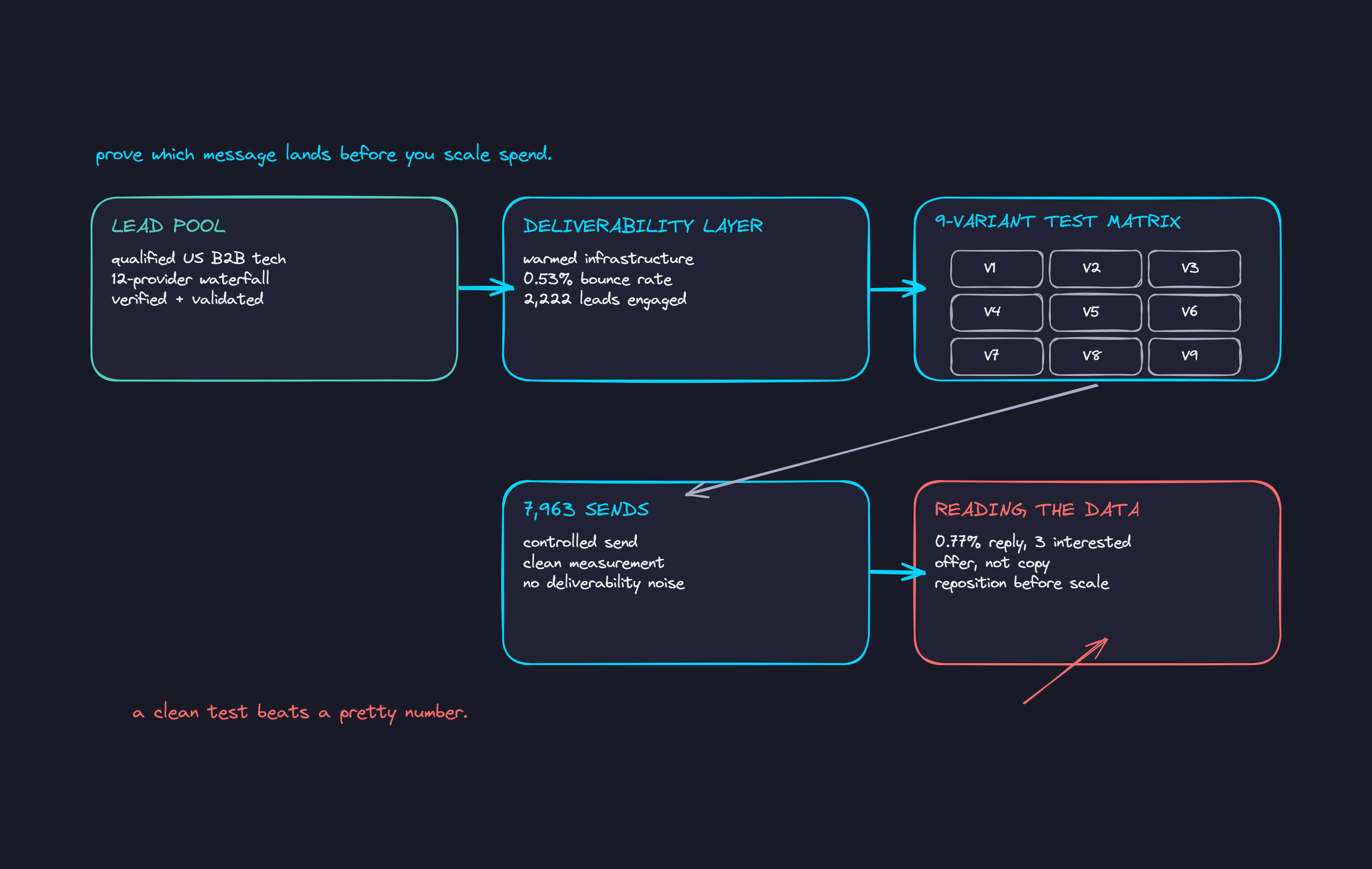
One engine, four layers. A qualified US B2B tech lead pool flows through a deliverability layer, into a 9-variant test matrix, out across 7,963 sends, and finally into reading what the data actually says.
Company intelligence pipeline
A Clay companies table with 47 enrichment and qualification columns: domain normalization and deduplication, AI ICP-fit scoring against 6 criteria as a pass or fail gate, funding and growth signal detection, and exclusion layers for DNC lists, competitors, and existing clients.
12-provider email waterfall
The people table ran 59 columns and a 12-provider sequential waterfall (BetterContact, Findymail, Hunter, Prospeo, Kitt, Datagma, Wiza, Icypeas, Enrow, Dropcontact, LeadMagic, SMARTe) with a Findymail verification gate on every address. Result: 0.53% bounce across 7,963 sends, in a market where 2 to 3% is acceptable.
9-variant AI copy test matrix
A two-agent setup: a signal-finding agent found what makes outbound relevant now, then a writing agent drafted the opener. 9 variants on Step 1, 3 on Step 2, a plain-text bump on Step 3, and 3 breakup variants on Step 4, across a 4-step plain-text sequence with tracking disabled.
Controlled send and read
A capped cadence of 250 leads per day, Monday to Friday, 9 AM to 6 PM Eastern, so every variant got a clean, comparable read. Then I read the reply data honestly rather than forcing a win out of it.
Results
What the test showed
The infrastructure worked exactly as designed: near-zero bounce, nine messaging angles read cleanly against each other. The finding was not a high reply rate. It was that at a 0.77% reply rate with 3 interested replies, the copy was not the bottleneck. The offer and positioning needed repositioning before scale. That is the honest read, and it is the point: I would rather hand a client a clean answer than an inflated one.
| Metric | Result |
|---|---|
| Total qualified leads loaded | 2,222 |
| Emails sent (4-step sequence) | 7,963 |
| Bounce rate | 0.53% |
| Reply rate (per unique lead) | 0.77% |
| Interested replies | 3 |
| Reading of that data | Offer, not copy |
| Sequence completion rate | 72% (1,600 of 2,222) |
| A/B variants tested | 9 (Step 1) + 3 (Step 2) + 3 (Step 4) |
| Company enrichment columns | 47 |
| Contact enrichment columns | 59 |
| Email providers in waterfall | 12 |
Want a clean read on your outbound before you scale it?
Book a 15-min callFit
Who this is for
- Agencies selling outbound services. If your own campaign has to be a live portfolio piece and your prospects grade email quality as a buying signal, the system has to be best-in-class.
- B2B companies targeting saturated US markets where deliverability and personalization quality decide whether you land in the inbox or the spam folder.
- Teams scaling cold outreach past 1,000 leads a month who need automated data pipelines, multi-provider verification, and AI-generated personalization they can trust.
Stack
Tools used






Ready to test your messaging before you scale it?
See how a clean, multi-variant test on pristine deliverability infrastructure tells you what actually works, before you spend on volume.
Book Your Free Strategy Call