
Most cold email doesn't fail on the copy. It fails on the timing. You can write the best four-line email in your category and still get a 3 percent reply rate, because you sent it to 2,000 people who had no reason to hear from you this week.
This is the part of outbound that almost nobody scopes correctly. Teams spend weeks A/B testing subject lines, rewriting the first line, tweaking the call to action. Then they wonder why the number won't move. The number won't move because the lever they're pulling isn't the one that's stuck. The copy was never the problem. The list was always going out at the wrong moment.
The teams pulling 15 to 20 percent reply rates in 2026 aren't writing dramatically better emails than you. They send at the moment something changes inside the account. That's the whole difference, and it's worth more than every copywriting trick combined.
The 3 percent problem is a timing problem
Here's the benchmark that should reframe how you think about outbound. Across billions of sends, generic list-based cold email averages a 3.43 percent reply rate (Instantly's 2026 Cold Email Benchmark Report). Signal-based outbound, where the send is triggered by a real buying behavior, runs several times higher. I've cleared 20 percent on the very same infrastructure, more on that below. Same product, same sender, same inbox. The only variable that changed is whether the email arrived at a moment the buyer actually cared.
Think about why that gap exists. When you send to a static list, you're betting that today, out of nowhere, a stranger wants to talk about their outbound, their hiring, their data stack. Most days, for most people, that bet loses. But when a company just hired a new VP of Sales, just closed a round, just posted a job that signals they're scaling a function, the bet flips. There is now a concrete reason this specific person wants to hear from you, and your email is the one that shows up referencing it.
The shift is easy to say and brutally hard to operationalize. Stop asking "who fits my ICP." Start asking "who in my ICP changed this week." That second question is where the replies live.

What a signal actually is
A buying signal is any observable event that suggests a company moved closer to needing what you sell. The strongest ones are not opinions, they're facts you can detect and act on:
- A new leadership hire in your buyer persona (a new VP, a new Head of, a new director)
- A funding round
- A product launch or major release
- A new certification, compliance milestone, or audit
- A government contract or major customer win
- A public incident, outage, or breach
- A spike in hiring for a function you serve
Each of those is a reason to reach out that did not exist yesterday. And each one tells you what to say. The email that references the thing that just happened reads like a person paying attention. The email blasted to a cold list reads like what it is.
The proof: a six-signal system for a 500-company market
I built exactly this for a US cybersecurity firm with a brutally small market: only 500 to 800 companies in their entire tier-one universe. Spray-and-pray was never an option. Send the same generic email to that whole list and you burn it in a month, with nothing to show for it and nowhere left to go.
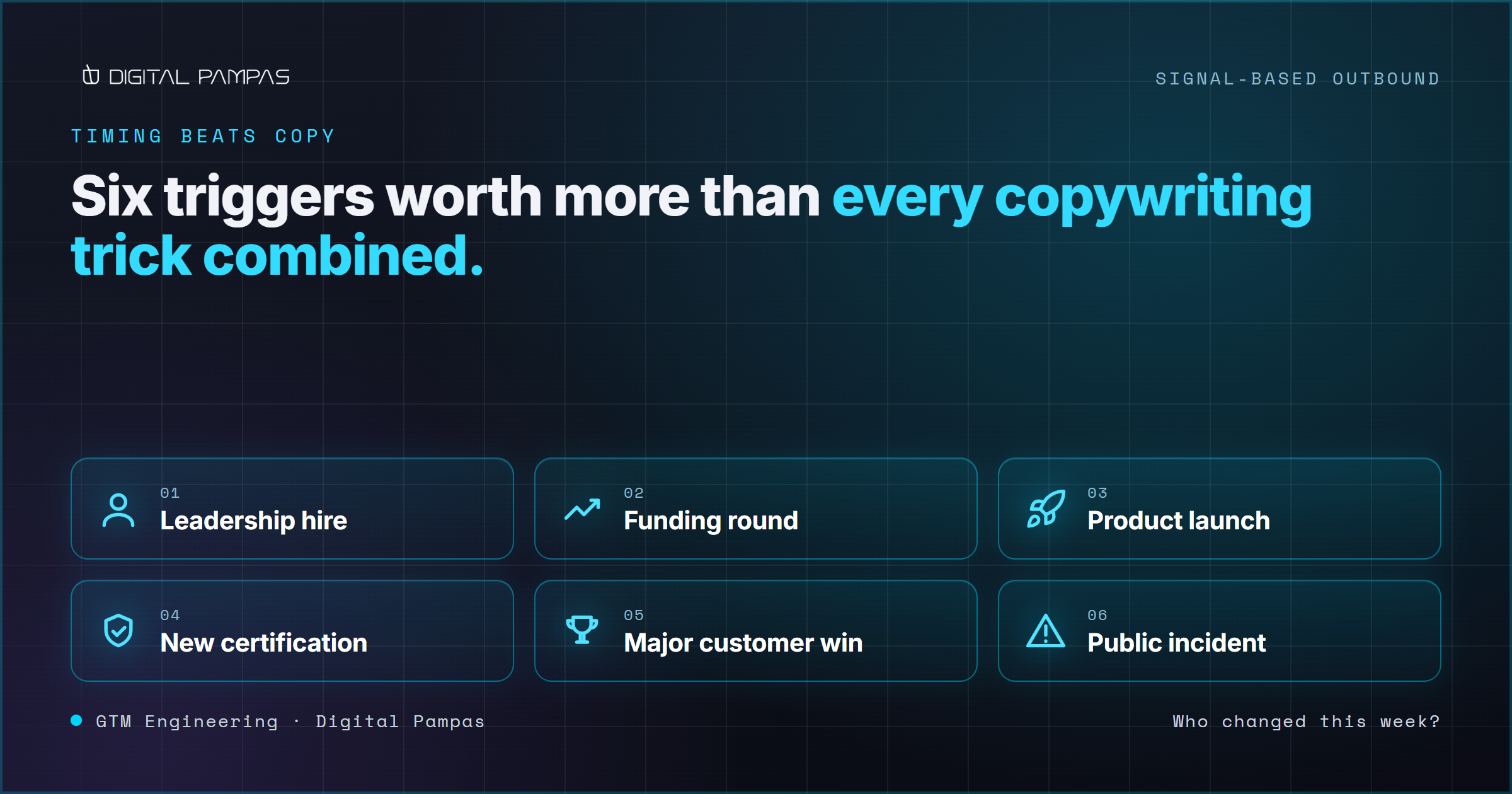
So instead of one list, we wired up six buying signals, each with its own detection logic and its own copy:
- new security leadership hire
- funding rounds
- product launches
- new certifications
- government contracts
- public security incidents
When a signal fired, the right email went out referencing the specific event. A new CISO got a different message than a company that just closed a Series B, which got a different message than a firm that just disclosed a breach. We enriched 25,000 contacts, went live in 27 days from contract, and held a 1.6 percent bounce rate across the build. Five of the twelve campaigns were signal-triggered, not volume-based.
That's the difference between treating a small market as a problem and treating it as an advantage. A small market is too small to spam, but it's exactly the right size to watch closely.
And this isn't a one-off. Across the portfolio I operate, the highest-replying campaigns are the signal-driven ones. A hiring-signal campaign I ran landed a 20.9 percent reply rate (300 replies on 1,435 sends, 53 interested). The same infrastructure, pointed at a trigger instead of a static list, produces a 6x better number. The signal is doing the work.
Speed is the second half of the equation
Detecting the signal is only half of it. The other half is acting before the window closes. Decades of lead-response research all point the same direction. Harvard Business Review's audit of more than 2,000 companies found the average firm takes 42 hours to respond to an inbound lead, and the ones that reach out within the hour are far likelier to qualify it (The Short Life of Online Sales Leads). The MIT and InsideSales study put a hard number on the same effect: contact a fresh lead within 5 minutes instead of 30 and you are up to 100 times more likely to connect and 21 times more likely to qualify it (Lead Response Management study). A buying signal decays the same way. A trigger you find on Tuesday and act on the following Monday is most of the way to being just another cold email again.
This is also why stacking signals beats chasing any single one. Accounts that show more than one trigger at the same time, say a funding round plus a hiring spike plus pricing-page activity, convert about 2.4x better than accounts with a single signal (Common Room). The more reasons that line up at once, the more in-market the account actually is. A system that watches for stacked signals is just a system that knows the difference between mild interest and a buyer with their hand up.
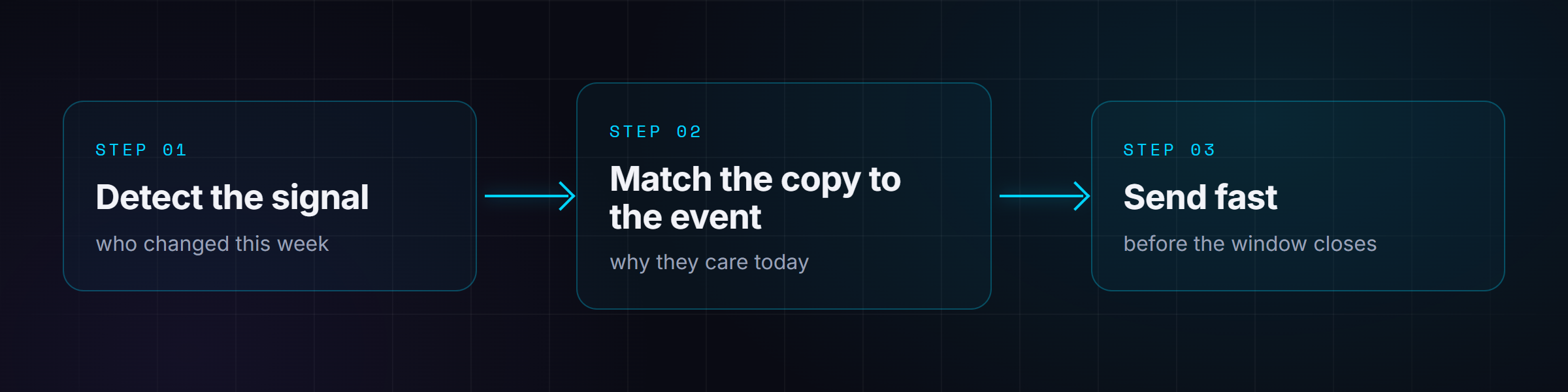
Break any one of those steps and the chain breaks. Detect a signal but send a generic email and you've wasted the trigger. Write perfect signal copy but send it a week late and you're cold again. The whole point is the three moving together.
Most teams don't have triggers at all
Here's the uncomfortable part. When I audit a stalled outbound program, the most common finding isn't bad copy or a bad tool. It's that there are no triggers anywhere in the system. The team built a list once, loaded it, and has been sending into it on a cadence ever since, hoping volume covers for relevance. It doesn't. It just burns the list slower.
If your outbound has plateaued and you're about to blame the copy, look at your triggers first. Ask a simple question: in the last campaign you sent, how many of those contacts had something change in the two weeks before you emailed them? If the honest answer is "we don't track that," you've found the lever that's actually stuck.
Building signal detection is not exotic. It's enrichment plus a watch layer plus copy that maps to each event, wired so a fired signal turns into a sent email fast. That's a system, not a setup. And it's the difference between an outbound program that compounds and one that quietly torches a list and calls cold email dead.
The teams winning in 2026 already stopped asking who fits their ICP. They're asking who changed this week. That's the question worth building your outbound around.
This is how I build outbound for clients: signal detection, enrichment, and copy that maps to the event, live in weeks not months. If your pipeline is plateaued, the one-week audit is where I'd start, or see the full cybersecurity case study behind the six-signal system above.